10 January 2014
Greetings for 2014 from Tanzania!
We were very concerned to hear about the brutal weather that overtook much of America last week. We hope (and prayed) that each of you stayed safe and that your homes/vehicles survived the assault.
Maybe we're having "sympathy pains," because I woke up this morning to find our bathroom flooded! Not sure what the problem is but of course it is Saturday so I don't know if we'll be able to get things fixed this weekend or not. (Ladd and 3 women from his church are arriving at 2 a.m. Monday!)
Since our last blog, we visited the island of Zanzibar for a few days over New Years Eve. It sounded like such a great idea and we thought it might help to distract ourselves from our homesickness of not being with family over Christmas by thinking of this exotic-sounding, spice island off the coast of Tanzania. It helped a bit ----until we got to the airport. There, to my enormous surprise, were hundreds of very happy, early-celebrating , "20-somethings" going to "Z-bar" (as I later found out it is called--for an obvious reason!) to bring in the New Year!!! I had to really work on my self-talk so as to not be negative about how crowded and raucous (and hot/humid) it would be. Somehow I instantly became very self-conscious of the age difference between us and our "plane-mates." I felt like we were on the boat going over to Put-in-Bay for a 4th of July weekend! Not exactly what I had in mind ....We were going to stay in Stone Town in one of the historic buildings--- at the Dhow Palace Hotel, built in 1559 A.D. (and of course, remodeled since then!) It was in the heart of Stone Town. When our 50 minute flight from Mt. Kilimanjaro Airport arrived at Zanzibar, the party-goers quickly retrieved their luggage and disappeared. I mean really disappeared! Zanzibar is 95% Muslim so there is no drinking allowed (at least in the city). Along the beaches, however, we later heard about the beach parties of 1000 "happy" people ushering out Old Man 2013 and welcoming the Little Baby 2014!
But, let me tell you that at the Dhow Palace Hotel, there were 2 occupants in the restaurant that night, and those same 2 had no clue when the New Year officially arrived because the Muslims use a different calendar based on the moon---so it was just another regular night for them! It was a very charming place and we really enjoyed the historical walking tour we took the next morning. Our guide was a well-read historian, and he made it all come alive!
While shopping in one of the stores, I noticed that it must have been nearly time for the Muslims required prayers that they pray 5 times a day. In a small closet-sized room, a black clad woman was conscientiously rolling out her mat and smoothing it with her hands as she began to kneel...and the Muslim call to prayer was issued from the nearby mosque for all in Stone Town to obey.
I couldn't help but wonder, how many time has she gone thru this? She looked as if she were probably 45 years old. Our guide said that they (the Muslims) start training their children during their pre-school years to pray 5 times/day. So, by my calculations, this woman has intentionally stopped what she's doing and "talked with God" 1,825 times a year or 73,000 times by the age of 45 years. And that doesn't include weekly services or special holiday worships!
I'm not trying to idealize this, but just think how much they are keeping God (and their relationship to God) in their mind even if it is a required practice. What would the world be like if we Christians thought of and talked with Christ that frequently? I think it'd make a difference. Hmmmm..........sounds like a New Year's Resolution in the making....
God's peace---and prayers for a "gentler" rest of January for each of you,
Tim & Diane
P.S. We ended our time in Zanzibar by going on a very interesting Spice Tour. That was 5 days ago...and for the past 5 days I have been covered with an extremely itchy allergic reaction to something I either touched, tasted, or inhaled there!!!! The doctor at the dispensary here said I should stop itching in 5-14 days!!!!
Saturday, January 11

Saturday, December 21
Views of life in Tz.
 Meet my newest friend! This is an eland that is one of many animals on the grounds of a nearby safari lodge.
Keep scrolling to next picture!


 A beautiful glimpse of Mt. Meru behind Makumira Campus.


A typical sight on the back of a taxi bus!
Tim holding a clump of bananas from a banana tree in our backyard!
Visiting at Upendo (Love) Leprosy Home. A very touching experience.
Diane working with a discussion group for a project assignment.
We were invited to the Confimation of our housekeeper's daughter. The celebrations are very special. Here she is seated with her escort. Next picture is of the village children who have little to eat and are invited at the end to come and enjoy what food is left.


Tanzanian images of Christmas
21 December, 2013
Merry Christmas!
Most of the students have left the campus by now, so the holiday has officially begun. However, Tim & I have to keep reminding ourselves of that because the tropical weather, and the lack of Christmas decorations make this time seem like any other day. So, in order to get into the Christmas spirit, I volunteered to lead the December meeting of a women's Bible study that I'm involved with. We appropriately chose to revisit the story of Christ's birth.
It's interesting, living in this country that still looks and continues many behaviors found in Old Testament times, to study and reflect on the Christmas story. Women in the villages still go to the well for the daily water. Goats, cattle, and sheep are staked to the side of the roads grazing on whatever they can find to eat while women pass by carrying over-sized bundles on their heads. Children can be seen collecting twigs for the cooking fire, and men are making bricks or doing carpentry work outside their small dukas.
Even the daily wear for village women is still to wrap themselves in fabric, printed with distinct patterns representing their tribe or marked with a wise saying. Cloth is valued here and used for everything from wrapping one's body, to transporting uncooperative loads of vegetables to market, to creating privacy in a one-room home, to giving protection from malaria laden mosquitoes while sleeping, to draping a deceased body before burial. . . . . to swaddling a newborn baby.
Many of the women in the group have lived in Tanzania for 20-30 years. Some have been here all their life, and others are relatively new, like me. So, together, we started the journey to Bethlehem---and took the long route there.
We began our journey at the beginning---and I literally mean the beginning ---with John as our guide (Jn. 1:1-5). So we knew from the start that we would be encountering God, the Word that became flesh and lived among us.
Then Matthew took over and expounded on the genealogy of Jesus. The women readily spotted the 4 women mentioned in this patriarchal lineage, and we realized the shock Matthew caused as we too live in a heavily male-privileged society. The insigificane of these women in the genealogy led us to have no doubt that God was at work.
Then Luke took over as our guide, and we women enjoyed the "knitty-gritty" inside story he shared. We trekked over to peak in on Elizabeth and Zechariah and we saw Elizabeth's tears of relief and joy as her long-endured disgrace was removed. Still today in Tanzania, childless, married women are a humiliation to their clan. The infertility is always considered hers, and the shame leaves deep, emotional scars as she is abused and shunned, often times even by her husband.
We'll never forget as we watched Mary deliver the Almighty Son of God. She swaddled him in bands of cloth like she had seen other women do countless times before...then she placed him ever so gently in that unsanitary manger! Honestly, we were so appalled! But that's how it is here in Tanzania as well. In the villages, it is the job of a mid-wife to help deliver the newborn---in the dirt-floored, mud-brick home. . .or. . .even in the middle of the banana tree filled plot---without sanitation, or instruments to prevent ripping, and without privacy. All the focus is on the newborn, expectantly waiting to see if the child is a boy.
Then no sooner had we caught our breath and the shepherds showed up! They looked and acted so much like the Maasai here that we almost thought we recognized one by name! Did you know they jumped high and let out their whooping, shrill noise when the first saw the baby? They did! (According to the New Testament RSV--Revised Sonnenberg Version). They were so excited that their Savior was one of them---born, not in a luxurious palace--but just like the shepherds---with the animals---one with creation. But quickly they became uncharacteristically quiet. I think the sight of their mighty Savior might have been too touching and tender---even for them, the brave and fearless shepherds.
And we were still around when the Wise Men showed up. Oh, the scent of those exotic fragrances and spices! The Wise Men seemed quite moved by this little king. We watched at how alert he was when they approached him. He held their gaze and he didn't blink. It was kind of a knowing kind of look he gave---one that went deep inside, past their eyes....almost as if he could see into their heart.
And then came the surprise. . . .it was our turn! We realized that we are in this story too. . .we are the Wise Women. (A Wise Woman is any woman who knows Jesus and loves Him with all her heart.) And like the Wise Men, we all came from different backgrounds, representing all parts of the earth. So what gift would each of us bring? What is most precious to us to offer to Him?
Well, that's where our journey ended. I told you we took the long route (and thus such a long blog entry!) But don't think you get off without being included too! You've also heard the story, and that adorable little one sees you as well. So what will you offer Him, our long-awaited Messiah?
Tim and I pray that all of us will be renewed with the same sense of curiosity and joy that the shepherds must have experienced on that ordinary night when the angels broke open the sky with their presence. We pray that we will be wrapped in the swaddling cloths of each other's love. And that our hearts will be moved like those of the Wise Men to go great lengths to learn more about Jesus---and then be empowered to go and tell others the Good News!
Wishing each of you, a truly Blessed Christmas,
Tim & Diane
Saturday, December 7
Daily Life in Tanzania
7 December, 2013
Dear Family & Friends,
Even having been in Tz. several times, we continue to learn what it means to be community.
In the space of less than one week, Makumira campus experienced both extremes on the emotions continuum--from the unexpected death of one of the students, in which literally the "whole body" grieved,--to the other end of total, unbounded joy and cheers 5 days later, as everyone joined to celebrate the 5 hour graduation of last year's class!
These same students and faculty came together willingly despite being from different tribes and religions, to support each other in sorrow and in joy---for the simple reason that they are "community."
The female student who was hit and killed by a car near campus, was in her last year of Education
studies. Her death had a profound impact on the students. A hush descended across the whole campus as students walked slowly, talking in whispered voices, if at all. That evening there was a Memorial Service on campus before sending her body 14 hours south to her home village. Her father and brothers were able to arrive just in time for the service so that they could escort their precious loved one home.
The chapel was packed beyond capacity as an additional hundreds of students (probably around 2000) sat on the ground outside surrounding the chapel--Christians and Muslims alike. Everyone did not know this student, but everyone shared in the tragedy her family and friends were experiencing---and out of respect, they came.
During the service, the casket was brought in and opened. Her father was introduced and seeing the large crowd, and bearing the shock of his daughter's passing, all he could do was lift his arm and bow his head. Sometimes there are no words--in any language.
At the end of the service, the students began to walk past the open casket, paying their respects while hymns were being sung in the deep voices and natural harmony so typical of Tz.
It was sweltering inside the chapel, and at times the students' processional became very emotional as many female students began screaming/wailing and passing out as they saw their friend for the first time since her death---and the last time in this life. Those who collapsed were carried out (almost like a corpse themselves) and laid on the ground outside the chapel. It was pitch black when we left the chapel, nearly stepping on bodies ourselves, as girls lay moaning, and students stood silent in small groups. And in their cultural expression of grief, they all gave and received support--and demonstrated what it means to be community---despite their many tribal/religious differences.
Then on Saturday, Graduation, the most festive day of the school calendar, occurred. The campus was spruced up, large white tents with colorful streamers were erected, chairs for students and faculty put in place, and huge bouquets of flowers were arranged. The participants were robed (note picture of "yours truly" trying to look dignified in robes that were too long / too short, and mortar boards that slipped off with each turn of the head!), and a ceremonial brass band warmed up as relatives and friends streamed in thru the campus gates. Actually it reminded Tim and me of being at an OSU football game (minus the delicious tailgating food.) (Go Bucks!)
That week was a lot for the students to handle. Unfortunately, death is too common of an occurrence here. The average lifespan in Tz. is 50 years...compared to 79 years in the U.S. During one class when we were studying Erikson's Developmental Stages, some students commented that "Our tribe doesn't go up to Stage 6 because we don't live that long." How does such a stark reality make these students feel?
Just one more experience to share--ironically on a happy note. Yesterday we decided to go on an adventure and try to find a place without directions--we only had the name of the village. The place is Upendo (Love) Leprosy Home operated by Sisters of the Precious Blood.
After several unsuccessful attempts, we were able to find a working phone number from an out-dated brochure. A welcoming voice (in English even) answered and gave clear directions up the mountain. We didn't know much about leprosy, or even the prevalence but thought maybe we should learn in case the seminarians also need accurate information. Sr. Feliciana, a young, selfless woman was waiting to greet us and show us around. While leprosy is not common in our area, it is still a major problem and is increasing in the rest of the country because people in the effected villages treat it by going to the witch doctor. By the time they realize the witch doctor is not helping, they have started losing fingers, their nose falls off, and their eyes are scaled over and blindness results. All this could have been avoided by seeing a medical doctor since medicines are available to treat and arrest leprosy.
Some families come to stay at Upendo so they can be with their children. But many come alone, rejected because of their stench, and frightening appearance. The nuns minister to them lovingly, cleaning their wounds, applying medicine, and nurturing them back to health with food from the garden and safe water to drink---and we saw the results--The blind responded to our voices and stuck out their handless limb for us to shake. If they could see, they would stand on footless legs and warmly greet us and thank us for coming. They come from regions throughout Tz where leprosy occurs--but here they live as a community brought together out of the darkness of disease and witchcraft into the healing light of Christ's saving love.
I think we just witnessed Advent. . . Tanzania style!
Well, dear family and friends, I apologize this is so long, but much was on my mind. Thank-you for being "our community."
May God's peace and wonder fill you as we light the 2nd candle on the Advent wreath.
Tim & Diane
Dear Family & Friends,
Even having been in Tz. several times, we continue to learn what it means to be community.
In the space of less than one week, Makumira campus experienced both extremes on the emotions continuum--from the unexpected death of one of the students, in which literally the "whole body" grieved,--to the other end of total, unbounded joy and cheers 5 days later, as everyone joined to celebrate the 5 hour graduation of last year's class!
These same students and faculty came together willingly despite being from different tribes and religions, to support each other in sorrow and in joy---for the simple reason that they are "community."
The female student who was hit and killed by a car near campus, was in her last year of Education
studies. Her death had a profound impact on the students. A hush descended across the whole campus as students walked slowly, talking in whispered voices, if at all. That evening there was a Memorial Service on campus before sending her body 14 hours south to her home village. Her father and brothers were able to arrive just in time for the service so that they could escort their precious loved one home.
The chapel was packed beyond capacity as an additional hundreds of students (probably around 2000) sat on the ground outside surrounding the chapel--Christians and Muslims alike. Everyone did not know this student, but everyone shared in the tragedy her family and friends were experiencing---and out of respect, they came.
During the service, the casket was brought in and opened. Her father was introduced and seeing the large crowd, and bearing the shock of his daughter's passing, all he could do was lift his arm and bow his head. Sometimes there are no words--in any language.
At the end of the service, the students began to walk past the open casket, paying their respects while hymns were being sung in the deep voices and natural harmony so typical of Tz.
It was sweltering inside the chapel, and at times the students' processional became very emotional as many female students began screaming/wailing and passing out as they saw their friend for the first time since her death---and the last time in this life. Those who collapsed were carried out (almost like a corpse themselves) and laid on the ground outside the chapel. It was pitch black when we left the chapel, nearly stepping on bodies ourselves, as girls lay moaning, and students stood silent in small groups. And in their cultural expression of grief, they all gave and received support--and demonstrated what it means to be community---despite their many tribal/religious differences.
Then on Saturday, Graduation, the most festive day of the school calendar, occurred. The campus was spruced up, large white tents with colorful streamers were erected, chairs for students and faculty put in place, and huge bouquets of flowers were arranged. The participants were robed (note picture of "yours truly" trying to look dignified in robes that were too long / too short, and mortar boards that slipped off with each turn of the head!), and a ceremonial brass band warmed up as relatives and friends streamed in thru the campus gates. Actually it reminded Tim and me of being at an OSU football game (minus the delicious tailgating food.) (Go Bucks!)
That week was a lot for the students to handle. Unfortunately, death is too common of an occurrence here. The average lifespan in Tz. is 50 years...compared to 79 years in the U.S. During one class when we were studying Erikson's Developmental Stages, some students commented that "Our tribe doesn't go up to Stage 6 because we don't live that long." How does such a stark reality make these students feel?
Just one more experience to share--ironically on a happy note. Yesterday we decided to go on an adventure and try to find a place without directions--we only had the name of the village. The place is Upendo (Love) Leprosy Home operated by Sisters of the Precious Blood.
After several unsuccessful attempts, we were able to find a working phone number from an out-dated brochure. A welcoming voice (in English even) answered and gave clear directions up the mountain. We didn't know much about leprosy, or even the prevalence but thought maybe we should learn in case the seminarians also need accurate information. Sr. Feliciana, a young, selfless woman was waiting to greet us and show us around. While leprosy is not common in our area, it is still a major problem and is increasing in the rest of the country because people in the effected villages treat it by going to the witch doctor. By the time they realize the witch doctor is not helping, they have started losing fingers, their nose falls off, and their eyes are scaled over and blindness results. All this could have been avoided by seeing a medical doctor since medicines are available to treat and arrest leprosy.
Some families come to stay at Upendo so they can be with their children. But many come alone, rejected because of their stench, and frightening appearance. The nuns minister to them lovingly, cleaning their wounds, applying medicine, and nurturing them back to health with food from the garden and safe water to drink---and we saw the results--The blind responded to our voices and stuck out their handless limb for us to shake. If they could see, they would stand on footless legs and warmly greet us and thank us for coming. They come from regions throughout Tz where leprosy occurs--but here they live as a community brought together out of the darkness of disease and witchcraft into the healing light of Christ's saving love.
I think we just witnessed Advent. . . Tanzania style!
Well, dear family and friends, I apologize this is so long, but much was on my mind. Thank-you for being "our community."
May God's peace and wonder fill you as we light the 2nd candle on the Advent wreath.
Tim & Diane
Saturday, November 16

 Diane visitng with child and mother at the Plaster House dedication. The Plaster House is a new facility under the direction of the Arusha Lutheran Medical Center. It is a place for children to staay for rehabilitation after having orthopedic surgery. You can see the "plaster" cast on the little girl's right leg.


Tim visitng with a group of boys at the Plaster House. The children stay there for up to two months, usually without their parents. There are "house mothers" who take care of them plus the rehab specialists and volunteers for education and play. Before this facility, they would return to their village right after surgery and not have the proper care or rehab.
You can see this little guy is a real "charmer!"
These are the 6 Tanzania women seminarians in our class. You can see the chapel in the background and that is the library on the left.
This is the pathway from the seminary to the seminary housing for its students.
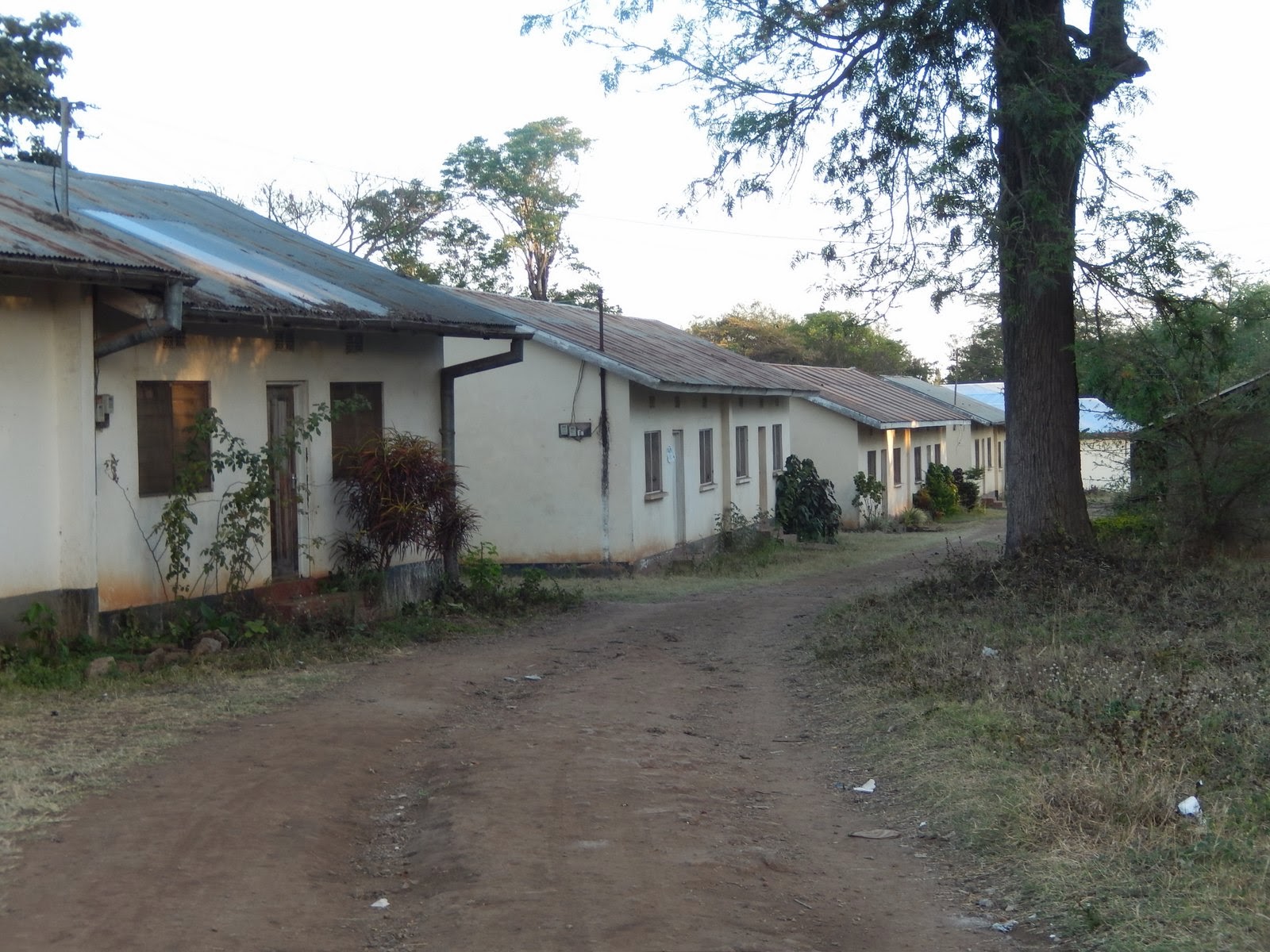
Seminary married student housing--two families per unit.
(Check out the blog, Tanzanian Culture" that should either follow or preceed these pictures!)
Tanzanian Culture
16 November, 2013
Dear Family and Friends,
When we first arrived at Makumira, I would awake every morning to the "exotic" (for lack of a better word) chant of the Imam from our neighboring village. I loved waking up to his prayers and readily joined my own prayers and praise with his. And it seemed that I wasn't the only one he awoke because an instant after his first few notes, the local rooster would join in with his scratchy sounding morning alarm---only to have the quacks of the "Afflack" bird (my name because I'm not sure what the real name is but it sounds like the duck in the Afflack commercials!) So the silent dawn suddenly breaks open over Tanzania in a very earthy, yet God-connected way. And in my heart I think, "This is Tanzania at its best!"
Well, I haven't heard the Imam for some time now. I don't know if he's ill (which is quite common here), or has moved away (which is unlikely), or if he has passed away. My hope is that maybe he used a microphone system (It never really sounded like it though) and the system broke. I don't know and there's really no way for me to find out because the Muslim mosque is in the village and only Swahili is spoken there. So I'll wait---along with the rooster and the Afflack duck/bird who continue to perform their duty, but there's definitely a lack without the Imam's prayers blessing the day.
Classes are going well and we are starting to know the students (and as a result their culture) better. In one of my classes we discuss the differences between individualistic cultures and collectivistic (group/tribal) cultures. After the lesson, the students identify what they think are the strengths and weaknesses of each. Their comments are interesting and I'm always amazed at their honesty and bluntness.
Regarding weaknesses of a tribal culture, several students talked about their culture being hierarchical. They stated that this social hierarchy is based on gender (males), birth order (first born), and age (the elderly). This puts women and children at the bottom with a childless woman being nearly an outcast.
One student wrote, "Few people may be powerful so it makes the others voiceless."
Several others commented on how knowledge and information are held by a few (usually elderly males) and only passed along to some. These seminary students saw this an an unfortunate tradition and admire cultures where "knowledge and information is freely available to any one who wishes to have it."
Another wrote: "No hurry" is a common saying, but time management is a problem here. (Oh, what an understatement!!! But an encouraging insight for change!)
Regarding weaknesses of an individual culture, one wrote: "An individual man remains with his problems."
And coming out of a strong, traditional, oral history, another student commented:"People in individualistic cultures forget history so don't learn from it."
The comment that has struck me most was by a student who said his group/tribal culture focuses on the spiritual rather than material. Then he went on to write, "You can't eat if your fellow is suffering from hunger because of your selfishness. We don't have the saying, "It's none of your business."
Sometimes we see ourselves more clearly through the eyes of the poor.
As we in the States begin to enjoy Thanksgiving, may we truly understand our abundance---just by being American.
Thinking of you with much love,
Tim & Diane (pictures will either follow or preceed this I think)
Dear Family and Friends,
When we first arrived at Makumira, I would awake every morning to the "exotic" (for lack of a better word) chant of the Imam from our neighboring village. I loved waking up to his prayers and readily joined my own prayers and praise with his. And it seemed that I wasn't the only one he awoke because an instant after his first few notes, the local rooster would join in with his scratchy sounding morning alarm---only to have the quacks of the "Afflack" bird (my name because I'm not sure what the real name is but it sounds like the duck in the Afflack commercials!) So the silent dawn suddenly breaks open over Tanzania in a very earthy, yet God-connected way. And in my heart I think, "This is Tanzania at its best!"
Well, I haven't heard the Imam for some time now. I don't know if he's ill (which is quite common here), or has moved away (which is unlikely), or if he has passed away. My hope is that maybe he used a microphone system (It never really sounded like it though) and the system broke. I don't know and there's really no way for me to find out because the Muslim mosque is in the village and only Swahili is spoken there. So I'll wait---along with the rooster and the Afflack duck/bird who continue to perform their duty, but there's definitely a lack without the Imam's prayers blessing the day.
Classes are going well and we are starting to know the students (and as a result their culture) better. In one of my classes we discuss the differences between individualistic cultures and collectivistic (group/tribal) cultures. After the lesson, the students identify what they think are the strengths and weaknesses of each. Their comments are interesting and I'm always amazed at their honesty and bluntness.
Regarding weaknesses of a tribal culture, several students talked about their culture being hierarchical. They stated that this social hierarchy is based on gender (males), birth order (first born), and age (the elderly). This puts women and children at the bottom with a childless woman being nearly an outcast.
One student wrote, "Few people may be powerful so it makes the others voiceless."
Several others commented on how knowledge and information are held by a few (usually elderly males) and only passed along to some. These seminary students saw this an an unfortunate tradition and admire cultures where "knowledge and information is freely available to any one who wishes to have it."
Another wrote: "No hurry" is a common saying, but time management is a problem here. (Oh, what an understatement!!! But an encouraging insight for change!)
Regarding weaknesses of an individual culture, one wrote: "An individual man remains with his problems."
And coming out of a strong, traditional, oral history, another student commented:"People in individualistic cultures forget history so don't learn from it."
The comment that has struck me most was by a student who said his group/tribal culture focuses on the spiritual rather than material. Then he went on to write, "You can't eat if your fellow is suffering from hunger because of your selfishness. We don't have the saying, "It's none of your business."
Sometimes we see ourselves more clearly through the eyes of the poor.
As we in the States begin to enjoy Thanksgiving, may we truly understand our abundance---just by being American.
Thinking of you with much love,
Tim & Diane (pictures will either follow or preceed this I think)
Friday, November 1
First Week of Classes Blog
November 1, 2013
Dear Family and Friends,
Classes have begun at Makumira and the seminary students are very happy about that! They love to learn and are very aware that it is a privilege not available to many, so they take it very seriously.
We have 27 Tanzanian students, plus 3 Germans, and 2 Danish students. This year we have a husband/wife combo, and a female pastor who grew up Muslim and has a heart-wrenching story about how she came to be a Christian.
It looks like another great class, full of Spirit, curiosity, and a sense of humor!
It is a bit of a challenge for Tim and I not only to remember the Tz. names, but also to get the right name with the right student. Actually it is a huge challenge for us, so I decided to make a seating chart and on the first day of class I explained that the students are to sit in the same seat at each class until I learn all their names. (Tim, on the other hand, told his Worship Class, which is composed of the same students, to wear the same outfit to class each time so he can recognize who they are! Fortunately, after a moment's hesitation, the students realized he was joking and thought it was very funny...little did they know...
Anyway, the next time my Psych. Class met, many of the students were sitting in different seats. I recognized this change in seating when I called "Emmanuel"---"Christina," and everyone in the class began to laugh (except for Emmanuel and Christina!) Then they explained to me that they had never heard of a seating chart before and they didn't want to sit where they sat the time before.
So, in an attempt at conflict management, I agreed that this new seating arrangement was absolutely fine. . . . and I'd adjust my seating chart. . . . but they need to keep these seats now. I then proceeded going between the aisles writing down students' names again and two of the students sitting next to each other gave the same name, or so I thought, and I commented to that fact---which resulted in another outbreak of laughter. Everyone started talking excitedly at the same time in an attempt to explain that "Imani" and "Amani" are not at all alike because one means "Faith" and one means "Hope." The students speak very fast and their English has a heavy Swahili/British accent so those names still sound the same when they pronounce them, but I'll take their word for it.
This comedy of errors didn't end there unfortunately. Then there was a student whose real name is "Beatus" but he said he wanted to be called "Bryant----Kobe Bryant" because he (Beatus) thinks Kobe Bryant is a great NBA basketball player and he (Beatus aka Bryant) loves basketball!
So, Bryant it will be....Then somehow there was an extra student. He said he was present. (I thought he thought I was taking roll call.) I agreed that he was present and again asked his name. (I'm sure by now you've figured this all out, buy remember I was still coming off the trauma of Amani/Imani.
By this time the class was again laughing hysterically and I wasn't sure if they were kidding me or not since I've never heard of any Tanzanian named "Present." Well, I guess there's a first time for everything!
The great, great, great news, however, is that the Power Point that I worked on all summer actually worked! First of all, we had electricity, and the presentation went without a glitch! This is a modern day miracle considering my technical abilities. The second day of class wasn't so impressive since we were without electricity---so I guess I'll win some and lose some!
Something that definitely is a "winner," though, are the 2 ringed notebooks equipped with all the class notes and actual copies of all the assigned readings for the Psychology Class. The students don't have textbooks here because of the expense. They copy all their lecture notes by hand and have to look up any assigned readings either in the library (few copies of the outdated books available) or on the internet, but the internet connection is often out for hours or even days. Needless to say, the students were really grateful for such a gift as their "own book." We explained that it was all made possible by Christians in America who gave money for our teaching here. They said several times to tell the people in America, "Asante sana, asante sana---Thank-you, thank-you."
On that note, Tim and I will close by also saying thank-you for your interest and your prayers. We hope this finds you healthy and life going well for you and your families.
I am attempting to add pictures so please scroll down and see if they follow (unless they ended up on the top of this article and then you will have already seen them by this point!)
God's peace,
Tim & Diane P.S. As of the writing of this draft, we are without electricity since this afternoon. Consequently I am writing by lantern and I just saw a gecko slither across the wall right in front of me--but that's ok (I keep telling myself ) because he eats mosquitoes and other creepy, crawly things!
Dear Family and Friends,
Classes have begun at Makumira and the seminary students are very happy about that! They love to learn and are very aware that it is a privilege not available to many, so they take it very seriously.
We have 27 Tanzanian students, plus 3 Germans, and 2 Danish students. This year we have a husband/wife combo, and a female pastor who grew up Muslim and has a heart-wrenching story about how she came to be a Christian.
It looks like another great class, full of Spirit, curiosity, and a sense of humor!
It is a bit of a challenge for Tim and I not only to remember the Tz. names, but also to get the right name with the right student. Actually it is a huge challenge for us, so I decided to make a seating chart and on the first day of class I explained that the students are to sit in the same seat at each class until I learn all their names. (Tim, on the other hand, told his Worship Class, which is composed of the same students, to wear the same outfit to class each time so he can recognize who they are! Fortunately, after a moment's hesitation, the students realized he was joking and thought it was very funny...little did they know...
Anyway, the next time my Psych. Class met, many of the students were sitting in different seats. I recognized this change in seating when I called "Emmanuel"---"Christina," and everyone in the class began to laugh (except for Emmanuel and Christina!) Then they explained to me that they had never heard of a seating chart before and they didn't want to sit where they sat the time before.
So, in an attempt at conflict management, I agreed that this new seating arrangement was absolutely fine. . . . and I'd adjust my seating chart. . . . but they need to keep these seats now. I then proceeded going between the aisles writing down students' names again and two of the students sitting next to each other gave the same name, or so I thought, and I commented to that fact---which resulted in another outbreak of laughter. Everyone started talking excitedly at the same time in an attempt to explain that "Imani" and "Amani" are not at all alike because one means "Faith" and one means "Hope." The students speak very fast and their English has a heavy Swahili/British accent so those names still sound the same when they pronounce them, but I'll take their word for it.
This comedy of errors didn't end there unfortunately. Then there was a student whose real name is "Beatus" but he said he wanted to be called "Bryant----Kobe Bryant" because he (Beatus) thinks Kobe Bryant is a great NBA basketball player and he (Beatus aka Bryant) loves basketball!
So, Bryant it will be....Then somehow there was an extra student. He said he was present. (I thought he thought I was taking roll call.) I agreed that he was present and again asked his name. (I'm sure by now you've figured this all out, buy remember I was still coming off the trauma of Amani/Imani.
By this time the class was again laughing hysterically and I wasn't sure if they were kidding me or not since I've never heard of any Tanzanian named "Present." Well, I guess there's a first time for everything!
The great, great, great news, however, is that the Power Point that I worked on all summer actually worked! First of all, we had electricity, and the presentation went without a glitch! This is a modern day miracle considering my technical abilities. The second day of class wasn't so impressive since we were without electricity---so I guess I'll win some and lose some!
Something that definitely is a "winner," though, are the 2 ringed notebooks equipped with all the class notes and actual copies of all the assigned readings for the Psychology Class. The students don't have textbooks here because of the expense. They copy all their lecture notes by hand and have to look up any assigned readings either in the library (few copies of the outdated books available) or on the internet, but the internet connection is often out for hours or even days. Needless to say, the students were really grateful for such a gift as their "own book." We explained that it was all made possible by Christians in America who gave money for our teaching here. They said several times to tell the people in America, "Asante sana, asante sana---Thank-you, thank-you."
On that note, Tim and I will close by also saying thank-you for your interest and your prayers. We hope this finds you healthy and life going well for you and your families.
I am attempting to add pictures so please scroll down and see if they follow (unless they ended up on the top of this article and then you will have already seen them by this point!)
God's peace,
Tim & Diane P.S. As of the writing of this draft, we are without electricity since this afternoon. Consequently I am writing by lantern and I just saw a gecko slither across the wall right in front of me--but that's ok (I keep telling myself ) because he eats mosquitoes and other creepy, crawly things!
Subscribe to:
Posts (Atom)